
Home › Patios & paving
Hard landscapingPATIOS & PAVING
A patio is only as good as what is underneath it. We dig out properly, build a real base and lay to falls so the water goes where it should. Sandstone, porcelain, natural stone and block paving across Buckinghamshire and Hertfordshire.
Or call Connor direct on 07738 008077
Most of the failed patios we get called out to look at failed for the same reason: the base. Slabs laid on five spots of mortar over whatever was already there will rock, sink at the corners and lift in frost, usually within two or three winters. It looks fine on the day it is finished, which is the problem.
We dig out to a proper depth, put in a compacted sub-base, and lay on a full mortar bed so every slab is supported across its whole face. It takes longer and it is the entire difference between a patio that lasts twenty years and one that needs doing again.
What we lay
Indian sandstone
Still the most popular choice round here, and for good reason — warm colours, riven surface, and it suits both the older brick and flint properties and modern extensions. It is porous, so it wants sealing, and it will green up on a north-facing side like anything else.
Porcelain
What most people ask for now. It does not stain, does not need sealing, keeps its colour and stays far cleaner than stone. It is more expensive to buy and slower to lay — it needs a primer on the back of every slab and it cuts slowly — but if you want a patio you never think about again, this is it.
Natural stone — limestone, granite, yorkstone
For period properties where sandstone would look wrong. Limestone in particular sits well against flint and old brick, which matters on the older houses around Chesham, Old Amersham and central Berkhamsted.
Block paving
Better suited to drives than patios in most cases, but it earns its place where you want a single surface running from the drive round to the back, or where a curved shape would waste half a pallet of slabs in cuts.
The parts people forget
- Falls. A patio has to shed water away from the house — roughly a centimetre for every metre. Laid flat, it puddles and eventually you get damp on the wall
- Damp course. The finished surface has to sit at least 150mm below the damp proof course. Patios laid too high are one of the most common causes of damp in a back room, and it is expensive to put right afterwards
- Drainage. Where a patio is large or the ground is heavy, it needs somewhere for the water to go — a channel drain or a soakaway, not just a hopeful slope towards a border
- Jointing. Brushed-in sand washes out and weeds follow. We point properly, or use a resin jointing compound where the joints are wide
- Edges. Unrestrained edges creep and drop. Every patio needs a proper edge detail, haunched in
Slopes and levels
A lot of gardens here are on a slope — the valley sides in Berkhamsted, the ground running up from the High Street in Chesham. A patio on a slope means either cutting into the bank with a retaining wall behind, or building out with a wall in front and filling. Both are proper construction jobs with foundations and drainage, not decorative walling, and it is where a lot of cheaper quotes quietly leave the work out.
Because we do the walls, the levelling and any tree work ourselves, a terraced patio is one job, one team and one price rather than three trades blaming each other.
Trees near the patio
Digging out a patio near a mature tree can kill it, and if that tree is protected, damaging it is a criminal offence even when nobody put a saw near it. Large parts of Chesham, Amersham and Berkhamsted are conservation areas. We check before we quote and design around the roots — see protected trees.
How we work
- Free site visit. We walk the garden with you, talk it through, sketch a rough plan on the spot and take measurements
- Detailed written quotation within 48 hours. Itemised, so you can see what each part costs and leave out anything you’d rather not do yet
- We build it on agreed dates, with our own team doing the clearing, groundwork and construction
- Everything goes. We’re licensed waste carriers, so the spoil and arisings leave legally and the paperwork exists
We don’t put prices on the website. The same job on a flat plot with a drive to the back, and on a sloping garden you can only reach through the house, are genuinely different jobs — any figure here would be a guess. The visit is free and gets you a real number.
Related work
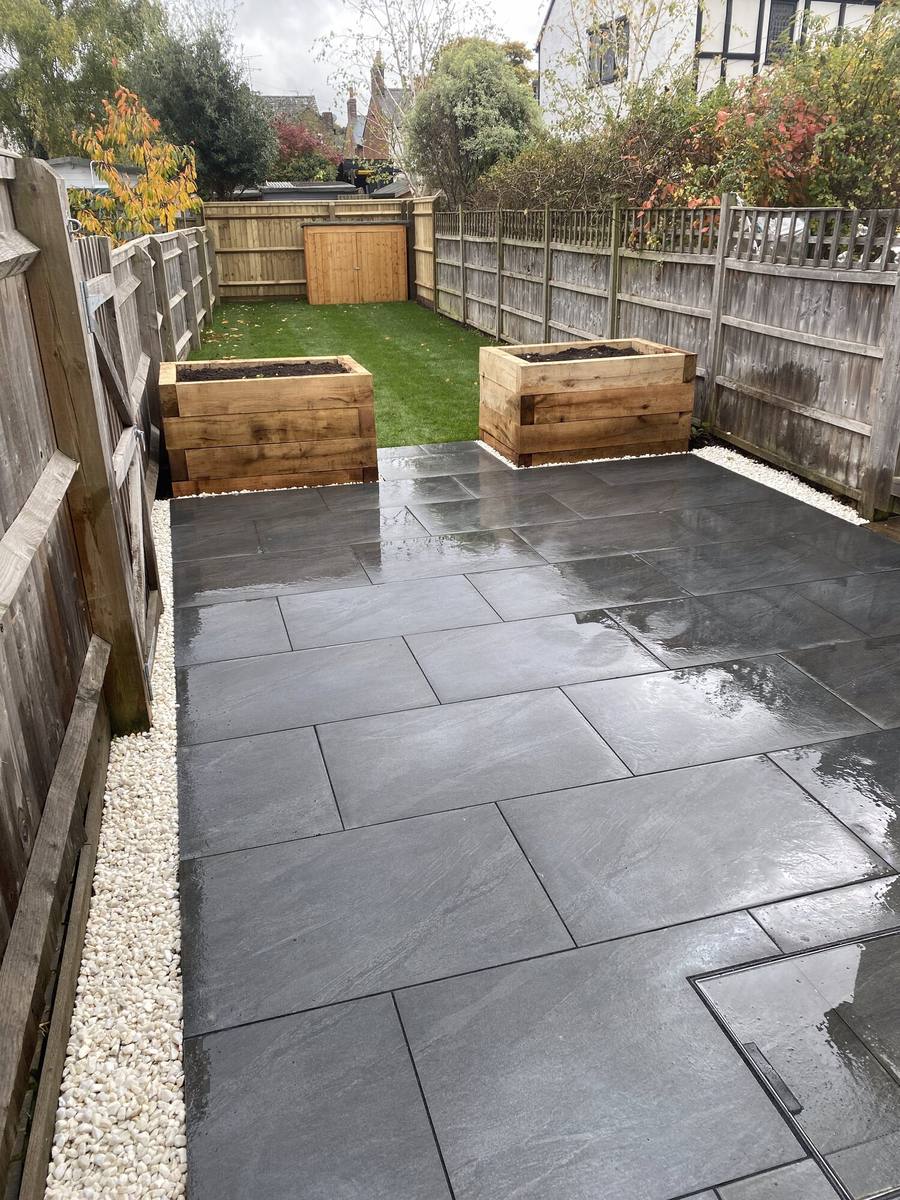
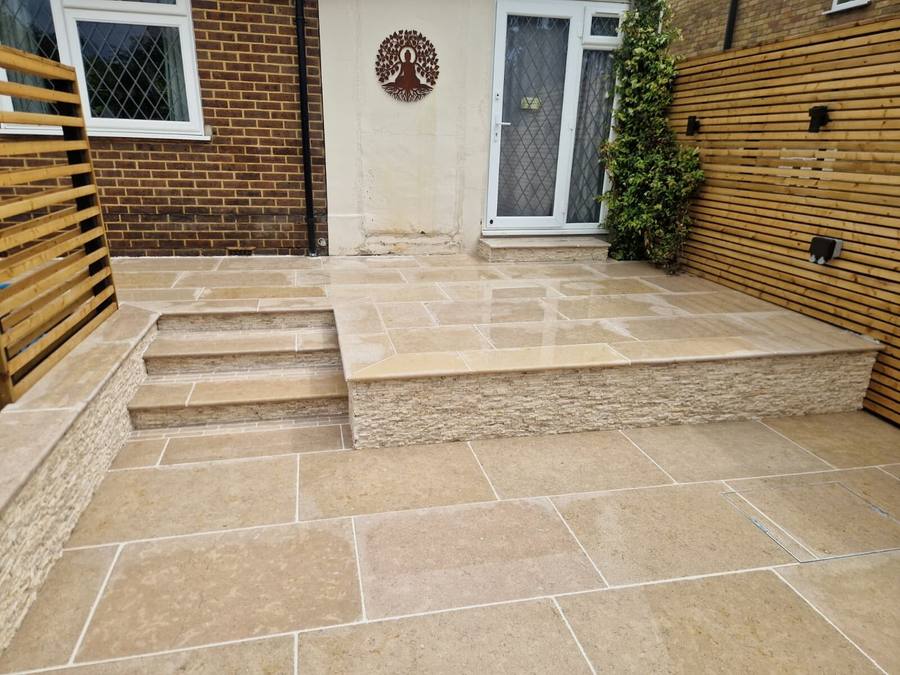
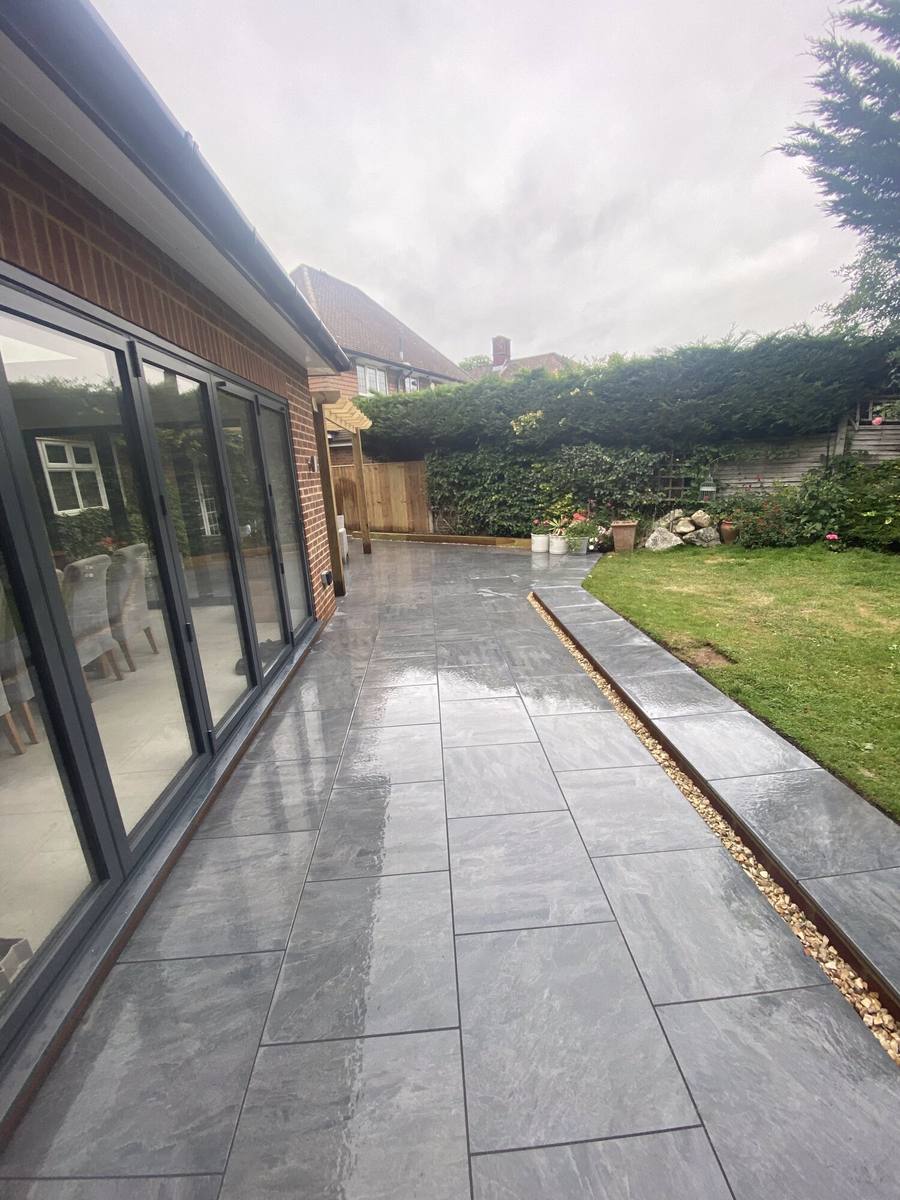
Porcelain, limestone and sandstone, all laid on a proper sub-base.
QUESTIONS WE GET ASKED
How long does a patio take?
A straightforward patio on a flat plot with decent access is usually three to five days. Add a retaining wall, steps, awkward access through the house, or ground that turns out to be full of flint or old concrete, and it grows. We give you a realistic number in the quote rather than an optimistic one, and we tell you straight away if weather is going to move it.
Sandstone or porcelain?
If you want the lowest price and a warm traditional look, sandstone. If you want to never think about it again, porcelain — it does not stain, does not need sealing and does not go green nearly as readily. Porcelain costs more to buy and takes longer to lay, so the gap in the finished price is bigger than the gap in the slab price. We will show you both at the visit.
Can you lay a patio over my existing one?
Almost never a good idea. You inherit whatever is wrong underneath, and you raise the finished level — which is how patios end up above the damp course and cause damp inside the house. We lift and dispose of the old one and start from the ground up.
Why do slabs go green?
Algae, and it is worse on north-facing and shaded areas, under trees, and on porous stone like sandstone. Sealing helps and so does keeping it clear of leaf litter. Porcelain suffers far less. It is cosmetic rather than structural, but it is worth knowing before you choose the material.
Do you take the old patio away?
Yes, and everything else that comes out. We are licensed waste carriers, so it goes to a proper facility with the paperwork to prove it. If a contractor is vague about where your waste is going, that is worth asking about — fly-tipped waste can be traced back to the householder.
Do I need planning permission for a patio?
Normally no, for a patio at ground level in a domestic garden. It can be different for a raised terrace overlooking a neighbour, in a conservation area, or on a listed building. We will tell you at the visit if it is a case where it needs checking.
BOOK A FREE SITE VISIT
We’ll walk the garden with you, go through your ideas, sketch a rough plan and take measurements. Your detailed quotation follows within 48 hours. No charge, no obligation.
GET A PROPER PRICE FOR YOUR PATIO
Call the office, ring Connor direct on 07738 008077, or book a visit online. Free, no obligation, and you get a detailed written quote afterwards.